Your Baby Is Not a “Velcro Baby”
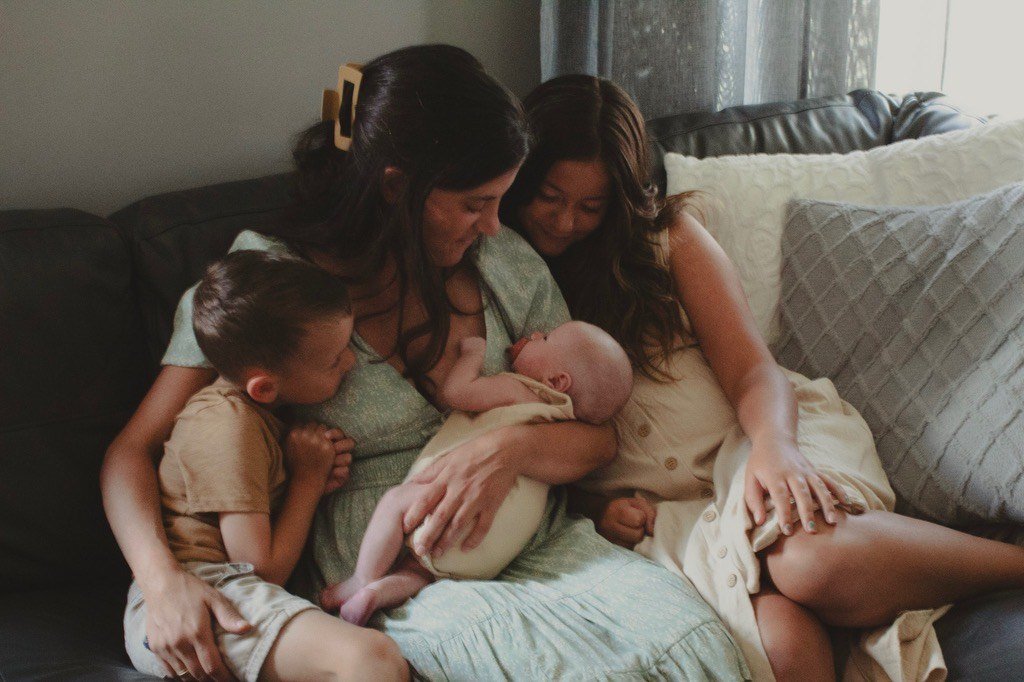
Maybe someone said it with a laugh.
“Wow, you’ve got a real Velcro baby.”
Maybe they meant no harm. Maybe they were trying to be lighthearted. Maybe they were trying to explain why your baby cries the second you pass them to someone else, or why they only settle on your chest, or why you can’t seem to pee, eat a full meal, or drink your coffee while it’s still hot.
But when you’re deep in the early days of mothering — tired, touched out, and wondering if you’re doing any of this “right” — those words can land heavier than people realize.
Because suddenly, what feels so primal, so natural, so all-consuming becomes framed like a problem.
Like your baby is too clingy.
Too needy.
Too dependent.
Too much.
But your baby is not a “Velcro baby.”
Your baby is a baby.
And especially in the first six months of life, it is profoundly, beautifully, biologically normal for them to want you — your smell, your skin, your voice, your heartbeat, your milk, your arms.
That’s not a bad habit.
That’s home.
They don’t know they’re separate from you yet.
For months, your baby lived inside of you.
They were held constantly, fed continuously, soothed by your movement, lulled by the rhythm of your heartbeat, and surrounded by the sound of your voice. They never had to wonder where safety was. They were wrapped in it every second of every day.
And then, all at once, they were born into a world that is bright, cold, loud, and unfamiliar.
Of course they want to be close to you.
Of course they settle when you hold them.
Of course they root for your breast when they’re overwhelmed.
Of course they cry when you put them down.
To us, it may look like preference.
To them, it is survival.
They do not know how to self-soothe.
They do not know how to “learn independence.”
They do not know that you’re just in the next room.
They only know that you are the place where everything feels right again.
For breastfed babies, this can feel even more intense.
Because the breast is never just food.
It is comfort.
It is regulation.
It is reconnection.
It is relief.
It is warmth.
It is safety.
A breastfed baby may nurse because they are hungry, yes — but also because they are tired, overstimulated, lonely, uncomfortable, unsure, or simply because being close to their mother helps their tiny system settle.
And in a culture that often values separation, schedules, and independence far too early, that can be deeply misunderstood.
But a baby who wants to nurse often, be held constantly, or sleep pressed against their mother is not doing anything wrong.
They are following biology.
Sometimes the hardest part isn’t even the baby’s need for closeness.
It’s everyone else’s commentary on it.
“You’re spoiling them.”
“They need to get used to other people.”
“If you keep holding them like that, they’ll never let you put them down.”
“They’re too attached to you.”
And if you’re already exhausted, already wondering if you’re somehow creating bad habits, those comments can get under your skin. They can make you question your instincts. They can make you feel like responding to your baby with love and closeness is somehow the wrong choice.
But babies are not manipulative.
They are not giving you a hard time.
They are having a hard time.
And you — your body, your presence, your responsiveness — are often what helps the world feel bearable to them.
That is not weakness.
That is not overdependence.
That is attachment doing what attachment is supposed to do.
You Are Not Making a Problem by Being Their Safe Place
There is so much pressure on mothers to make babies more independent before they are ready.
To put them down more.
Stretch feeds.
Stop contact naps.
Encourage separation.
Teach them to settle without being held.
But the truth is, babies do not become secure by having their need for closeness ignored.
They become secure by learning, over and over again, that when they need comfort, someone comes.
That they are heard.
That they are held.
That they are safe.
Dependency is not the failure of development in infancy.
It is the foundation of it.
And one day, slowly and in their own time, that baby who could not bear to be put down will crawl away to explore.
Then walk.
Then run.
Then build a life beyond your arms.
Not because they were forced away from closeness early,
but because closeness gave them the security to grow.
And still - this can be so hard.
Knowing something is biologically normal does not erase the exhaustion of being the one your baby wants every hour of the day and night. It does not erase how isolating it can feel to have a baby who only settles for you. It does not erase the ache in your back, the cold cup of coffee, the naps you spend trapped under a sleeping baby, or the way your nervous system can start to feel frayed by constant contact.
You are allowed to love being their safe place and still feel overwhelmed by the weight of it.
You are allowed to understand your baby’s needs and still wish someone was taking better care of yours.
Mothers were never meant to do this alone.
If a baby is meant to be held, then the mother is meant to be held too — by community, by support, by people who understand that the answer is not to harden her against her baby’s needs, but to soften the world around her enough that she can keep responding to them.
Maybe instead of calling babies “Velcro,” we could tell the truth.
Maybe we could say:
This baby feels safest close to their mother.
This baby is still adjusting to life outside the womb.
This baby is behaving exactly like a human infant is designed to behave.
Maybe we could stop treating normal attachment like an inconvenience.
Maybe we could stop asking mothers to fight biology in the name of making other people comfortable.
Maybe we could honour the intensity of this season instead of pathologizing it.
Because a baby who wants their mother is not broken.
They are not too much.
They are not manipulative.
They are not “bad.”
They are little.
They are new.
They are wired for closeness.
And in the first six months of life, especially for breastfed babies, their mother is not just a person they like best.
She is regulation.
She is familiarity.
She is nourishment.
She is safety.
She is home.
So if your baby cries when someone else holds them, naps best on your chest, wants to nurse around the clock, or seems to need your body more than you ever imagined possible, it does not mean you’ve created a problem.
It means your baby is asking for what is normal.
And if you are the one carrying that weight right now — tired, needed, stretched thin, and wondering whether this intensity is okay — let this be your reminder:
Your baby is not a “Velcro baby.”
Your baby is doing what babies have always done.
And you are not failing because they need you so deeply.
You are simply the place they know as home.
By Christina King - Birth & Postpartum Doula